
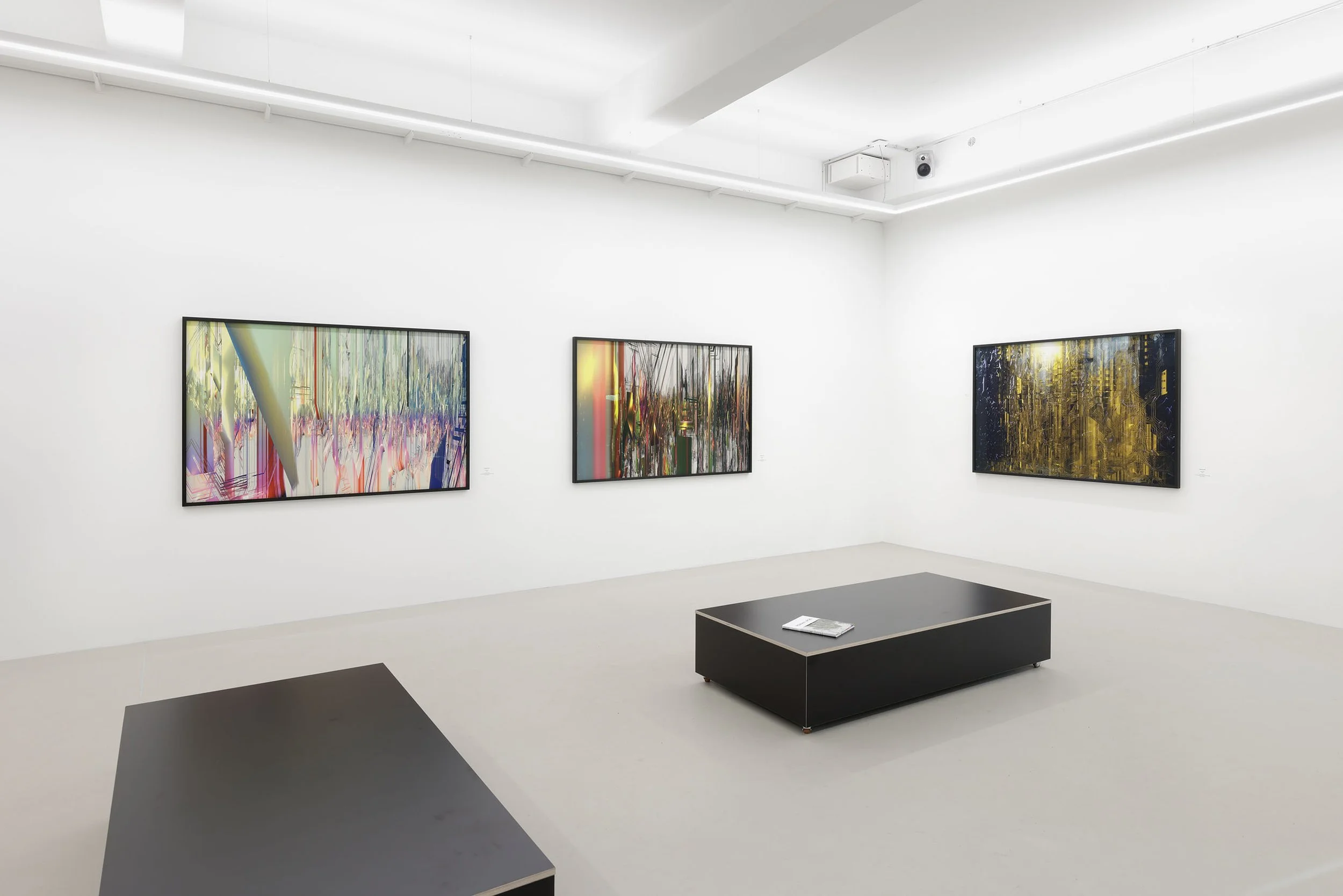
Quantum Babylon
Roman Lipski
Nov 1 – Dec 10, 2025 Daily, 11am – 4pm
Atelier Roman Lipski Wiener Straße 10, 10999 Berlin
After its premiere at the National Museum in Szczecin, Quantum Babylon comes back to where it began: the studio of Roman Lipski in Berlin-Kreuzberg. In the space where the works were imagined, tested and made, video, textile and print come together as one immersive environment.
The ancient story of Babel tells of people who build a tower to reach the sky and end up no longer understanding one another. It is a story about ambition and failure, and also about what people can achieve together. Lipski takes up this image at a moment when quantum computing is changing how we think about information, chance and certainty. His tower is never finished. It rises, falls apart and takes on new shapes, much as our relationship with technology does.
Every motif in the exhibition starts with a quantum algorithm. Using Quantum Brush, an open-source painting tool developed with physicists and researchers, Lipski turns the probabilities of quantum systems into textures and fields of colour. The results move between chance and order, between intuition and code. In the large-scale fine-art prints they become surfaces to explore with the eye. In the hand-woven Qarpets made of sheep’s wool they become something to touch. Visitors walk across them, sit on them and become part of a living system in which human and machine, analogue and digital, science and poetry overlap.
Quantum Babylon does not celebrate technology, and it does not warn against it either. Instead it asks a quiet question: what does it mean to create, and to make meaning, when the tools we use follow rules we can barely grasp? The exhibition offers no fixed answers. It invites visitors to look, listen, touch and stay a while, and to see the future as something we build together.
Roman Lipski (b. 1969) is one of the pioneers of technology-based art. He began working with artificial intelligence in 2016. In 2019 he developed the software Quantum Blur together with Dr James Wootton and Marcel Pfaffhauser, and since 2025 he has been painting with Quantum Brush. His works are held in collections including the Julia Stoschek Foundation, the Alex Katz Foundation, Sammlung Marx and the Museum of Fine Arts, Boston.
The event is part of Berlin Science Week and offers rare insights into one of the leading practices at the intersection of art and quantum science.
More information on Quantum Brush can be found here: Quantum Brush: A quantum computing-based tool for digital painting.