
Quantum Qualia
Roman Lipski
On view during Berlin Art Week
11am – 4pm
Closed on Sunday
Atelier Roman Lipski Wiener Straße 10, 10999 Berlin
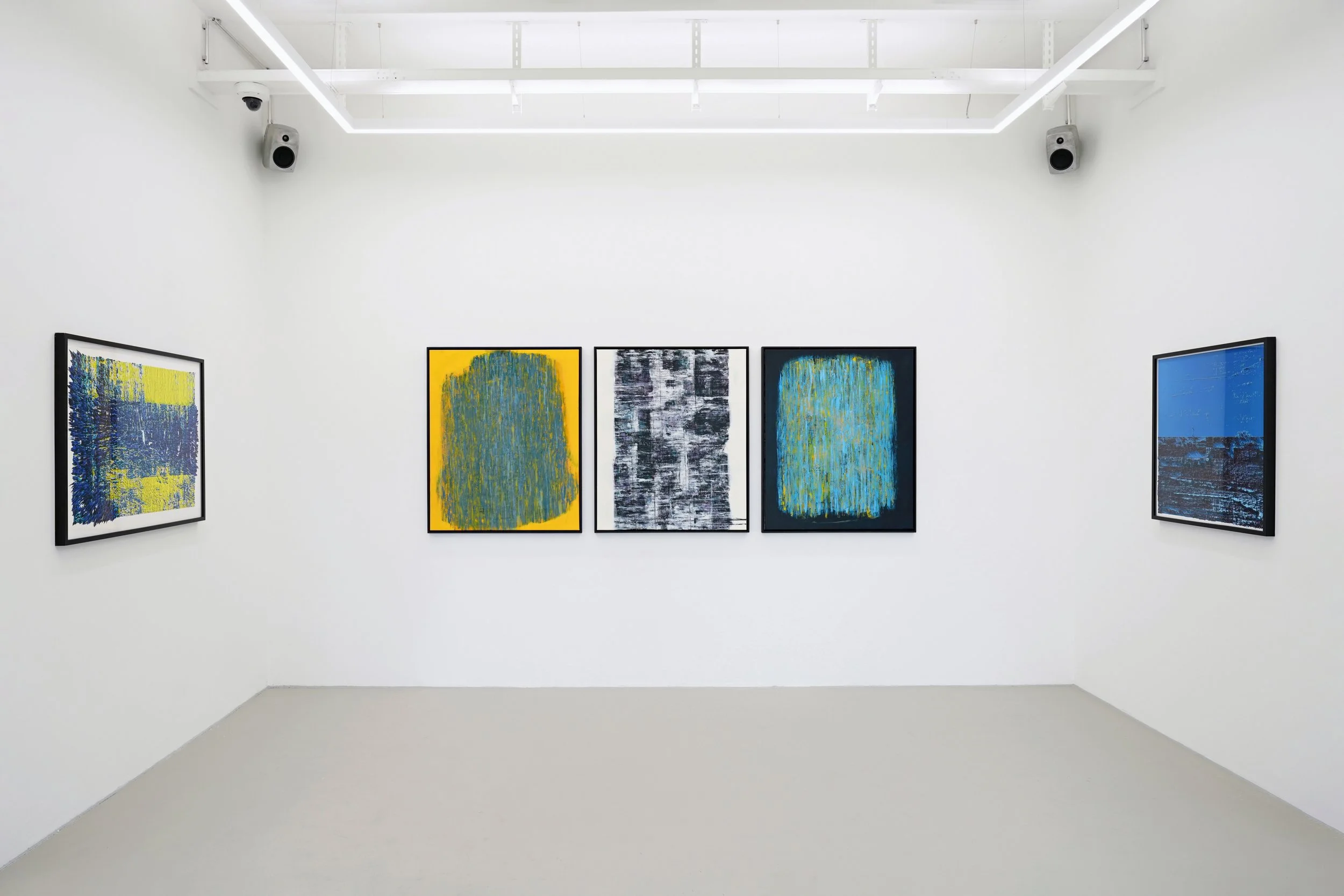
Atelier Roman Lipski presents Quantum Qualia, an exhibition built around the anomalies that make a system visible: missing atoms, incomplete bonds, and behaviors that resist an intended order. Bringing together new acrylic paintings from 2026 with four Untitled works from Lipski’s Quantum Blur series of 2021, the exhibition traces how scientific images and quantum concepts are transformed through color, scale, blur, and material structure.
In philosophy, qualia names the subjective qualities of conscious experience - the felt character of perception. Lipski places the term alongside quantum uncertainty, establishing a conceptual rather than explanatory relation: scientific instruments produce data, but an image is always encountered by a particular viewer. Developed following Lipski’s artistic residency with NCCR SPIN at the University of Basel, the exhibition draws on research images used to assign molecular charge states, map dangling bonds, and classify defects in two-dimensional semiconductors. These specific scientific conditions - charge, incomplete connections, and absent matter - become the starting points for the paintings.
Translated into paint, these conditions acquire a sensory presence. In Assignment, luminous forms gather against a dark field, suspended between emergence and disappearance. In Dangling Bond I and Dangling Bond II, repeated structures evoke connections left incomplete. The nine-part Missing Atoms series makes absence its organizing principle. Colored formations gather around gaps and displaced centers. In the research that informed the works, such defects can alter a material’s electronic properties. Lipski turns that physical fact into a visual proposition: absence is active; it reorganizes everything around it. A system may be defined as powerfully by what it lacks as by what it contains.
Lipski was particularly drawn to features that complicated the scientists’ intended configurations. “Everything that is unwanted by the scientists looks great,” he observes. “These elements appear like glowing points on a cold surface.” What scientific research registers as deviation, painting enlarges, colors, and gives new sensory force. The monumental Unusual Phase 1, measuring three meters across, unfolds as a turbulent field of cyan, black, and white. Unusual Phase 2 draws yellow, gray, and black forms into a more insistent rhythm. Across the five OK Quantum Computer paintings, circular gestures and vertical striations range from saturated fields to an abraded near-monochrome. Patterns form, fracture, and begin again.
Quantum physics also changed Lipski’s process. Finding the line too absolute for his subject, he turned to sfumato, allowing forms to pass into one another through blurred transitions. He prepares the relief surfaces before applying acrylic paint, giving physical depth to compositions informed by scientific and digital space. Although their titles refer to quantum computing, the 2026 canvases are constructed and painted entirely by hand. “I am painting with quantum,”Lipski says, “but I am painting with brushes.”
The four Untitled works from 2021 were created with Quantum Blur, an image-processing method developed by researchers at IBM Research Zurich using quantum operations. Printed on Koh-I-Noor paper, their fragmented topographies retain a connection to Lipski’s earlier practice as a landscape painter. By altering their perspective, he transformed frontal surfaces into spaces with apparent horizons, heights, and depths. Presented alongside the new canvases, the prints reveal a continuity in Lipski’s practice: spatial depth first encountered through software returns as physical relief, while computational distortion reappears through accumulated color and blurred edges. Lipski experimented with Quantum Blur in dialogue with the researchers behind the software, contributing an artist’s perspective on its visual possibilities.
Quantum Qualia asks what painting can do once matter has been translated into data. Lipski transforms information into experience, giving uncertainty color, texture, scale, and form.
Text by Ana Novi